
Lane County Arrest Records and Court Charges
Lane County arrest records describe the law-enforcement and jail side of a criminal event: who arrested the person, when the booking occurred, what the arresting agency listed as charges, and what public custody details are releasable. The Lane County Web Jail Viewer sample shows the booking layer clearly, including violation statute, charge description, level, arrest agency, agency case number, arrest date, court type, court case number, next court date, and required bond or cash fields.
The court-charge record starts after the arrest when the Lane County District Attorney or another prosecutor files a complaint, information, indictment, citation, or amended charge with the proper court. Police can arrest and book a person, but the prosecutor determines what charges to file in many Circuit Court criminal cases. From that point, OJD case records track arraignment, plea, amended charges, hearings, disposition, sentence, and financial obligations.
The Lane County inmate records path is the custody and booking side. The larger case file and final outcome belong with criminal court records. The key comparison is where arrest records and court charges after arrest meet.
The Lane County Sheriff FAQ is a source for police records, civil process, property/evidence, and sheriff administration contact details.
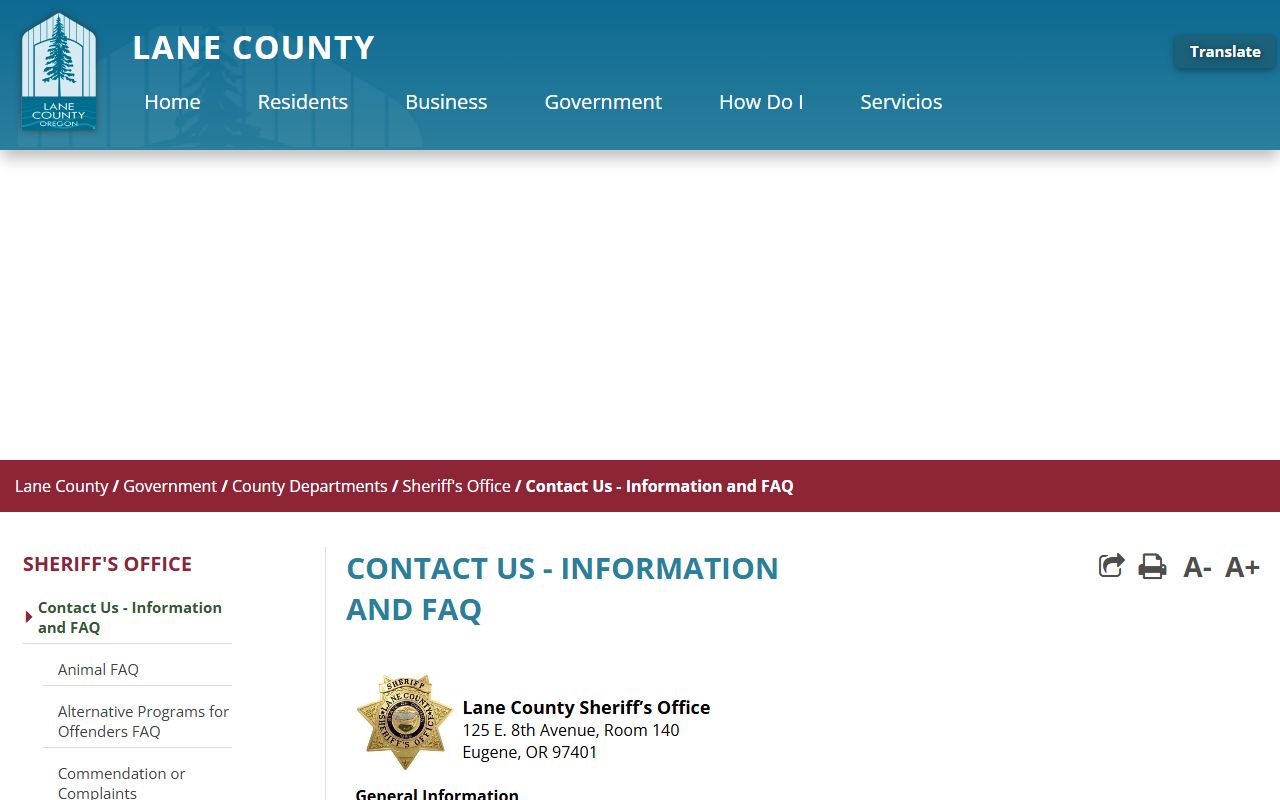
Those sheriff contacts help with agency-held records, while formal charges and case outcomes must be checked through the court and prosecutor pathway.
How to Find Lane County Arrest Records and Charges
Start with the record type that matches the question. For booking charges, use the Web Jail Viewer. For filed charges, use OJD Online Records Search for Lane County Circuit Court or the relevant municipal or justice court. For copies of jail records or mug shots, use the jail records request channel when the record is releasable by law.
- Search the Lane County Web Jail Viewer by last name, first name, and booking date range to locate the booking record.
- Open the booking detail and note the arrest agency, agency case number, charge descriptions, court type, court case number, War.# fields, next court date, and bond/bail fields.
- Search OJD Online Records Search by defendant name, case number, or citation number for Lane County Circuit Court filings.
- If the matter is municipal or justice court based, check the appropriate city or justice court rather than assuming it is in Circuit Court.
- Read the filed charge list, charge level, events, disposition, and financial sections. The filed charge can differ from the booking charge.
- Request official copies from the court or jail records channel when a public search result is not enough.
The Lane County Web Jail Viewer search page is the booking search source for Lane County custody entries.
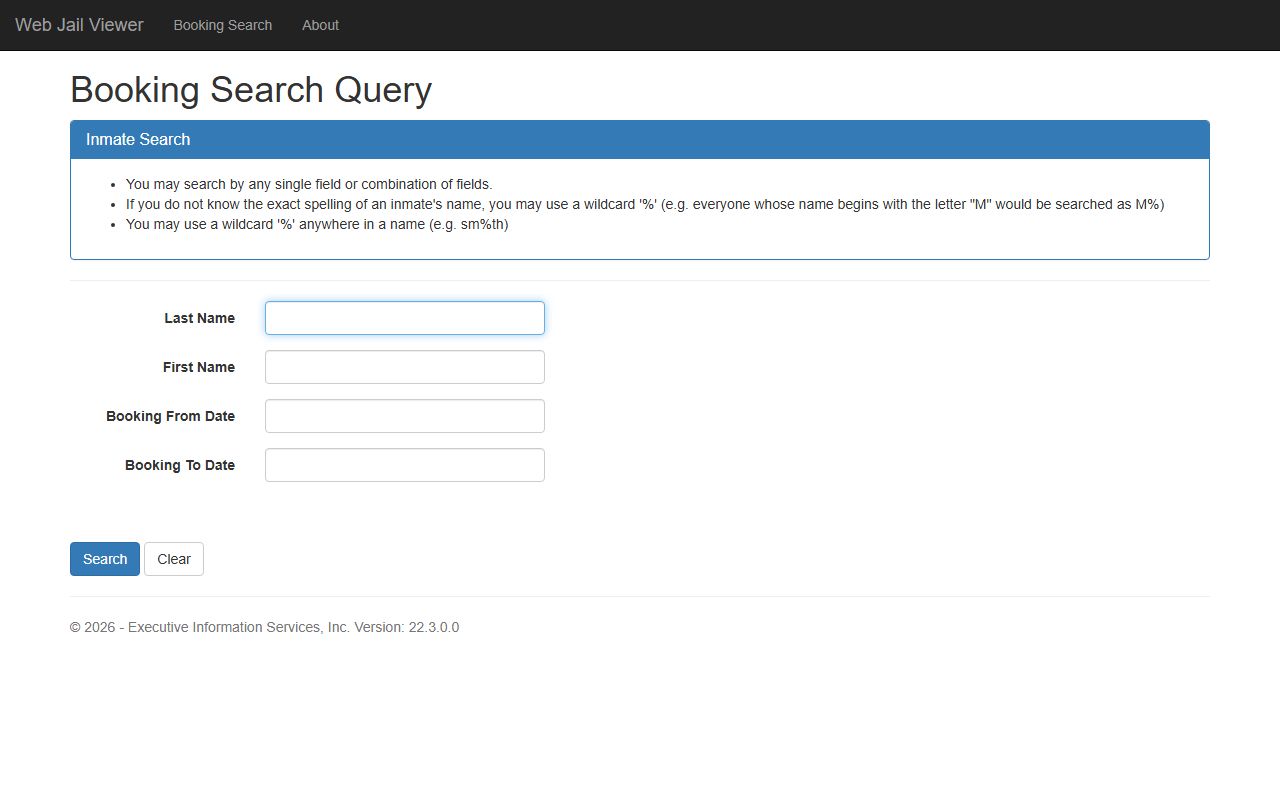
The viewer can identify the booking event and arresting agency, but the filed court charge still has to be checked against the court record.
How Charges Get Filed After an Arrest
Charges after arrest can reach the court in different charging documents. A complaint may start a case based on law-enforcement or prosecutor allegations. An information is filed by a prosecutor and is commonly used to charge crimes without a grand jury indictment where allowed by procedure. An indictment is a grand jury charging document. The document type matters because it marks the transition from booking allegation to filed court accusation.
| Document Type | Filed By | Common Use | Record Significance |
|---|---|---|---|
| Complaint | Officer or prosecutor | Initial criminal or violation case filing | Can begin the court case and state the alleged offense. |
| Information | Prosecutor | Many prosecutor-filed criminal charges | Shows the DA charging decision after review. |
| Indictment | Grand jury | Serious felony matters and grand jury filings | Shows charges returned by a grand jury. |
| Citation | Law enforcement or authorized agency | Traffic, violation, and some lower-level matters | May function as the case-starting document for citation-based proceedings. |
| Amended charging document | Prosecutor or court-approved filing | Changed, added, reduced, or corrected charges | Explains why the filed charge list differs from the booking list. |
Charge Status and What It Means
Charge status changes as a case moves. A booking charge can be cleared in the jail viewer while a court charge remains pending. A prosecutor can amend or reduce a charge. A court can dismiss a count. A conviction can follow a plea or verdict. A person reading Lane County arrest records should avoid treating the first charge list as the final result.
| Status | What It Means |
|---|---|
| Booking charge | The arresting agency's listed charge at jail intake; it may change after prosecutor review. |
| Pending | The filed court charge is active and has not reached final disposition. |
| Amended | The charge has been changed by later filing or court action. |
| Reduced | The charge has been lowered to a different offense or severity level. |
| Dismissed | The charge was ended without a conviction on that count. |
| Convicted | A guilty plea, no-contest plea treated by the court, or verdict resulted in conviction. |
| Cleared in booking detail | A jail-viewer clearance label tied to the booking charge; confirm court status separately. |
Charges vs. Convictions
A charge is an accusation. A conviction is an outcome. Lane County public records can show charges that were later dismissed, amended, reduced, or resolved by acquittal. Background or screening decisions should not treat an arrest, booking, or filed charge as proof of conviction.
| Comparison Point | Charge | Conviction |
|---|---|---|
| Stage | Accusation after arrest, citation, complaint, information, or indictment. | Final result after plea, verdict, or qualifying court finding. |
| Proof level | Based on probable cause or formal allegation. | Requires proof beyond a reasonable doubt or a plea accepted by the court. |
| Where it appears | Booking record, charging document, docket, and case events. | Disposition, judgment, sentence, and related court events. |
| Can change | Yes, charges may be amended, reduced, added, or dismissed. | Yes, but usually through appeal, set-aside, post-conviction, or later court order. |
| Public meaning | Shows an allegation, not guilt. | Shows the court outcome for that offense. |
War.#, Bond, and Court Fields in Booking Records
The Lane County sample booking detail is useful for reading arrest-to-charge data. It showed custody status, booking number, inmate ID, booking date, personal description, charges, violation statute, charge description, level, additional description, OBTS #, War.#, end of sentence date, clearance, arrest agency, agency case number, arrest date, court type, court case number, PC, next court date, required bond/bail, bond group number, required bond amount, required cash amount, and bond company number.
The Lane County sample booking detail is the source for the field inventory.
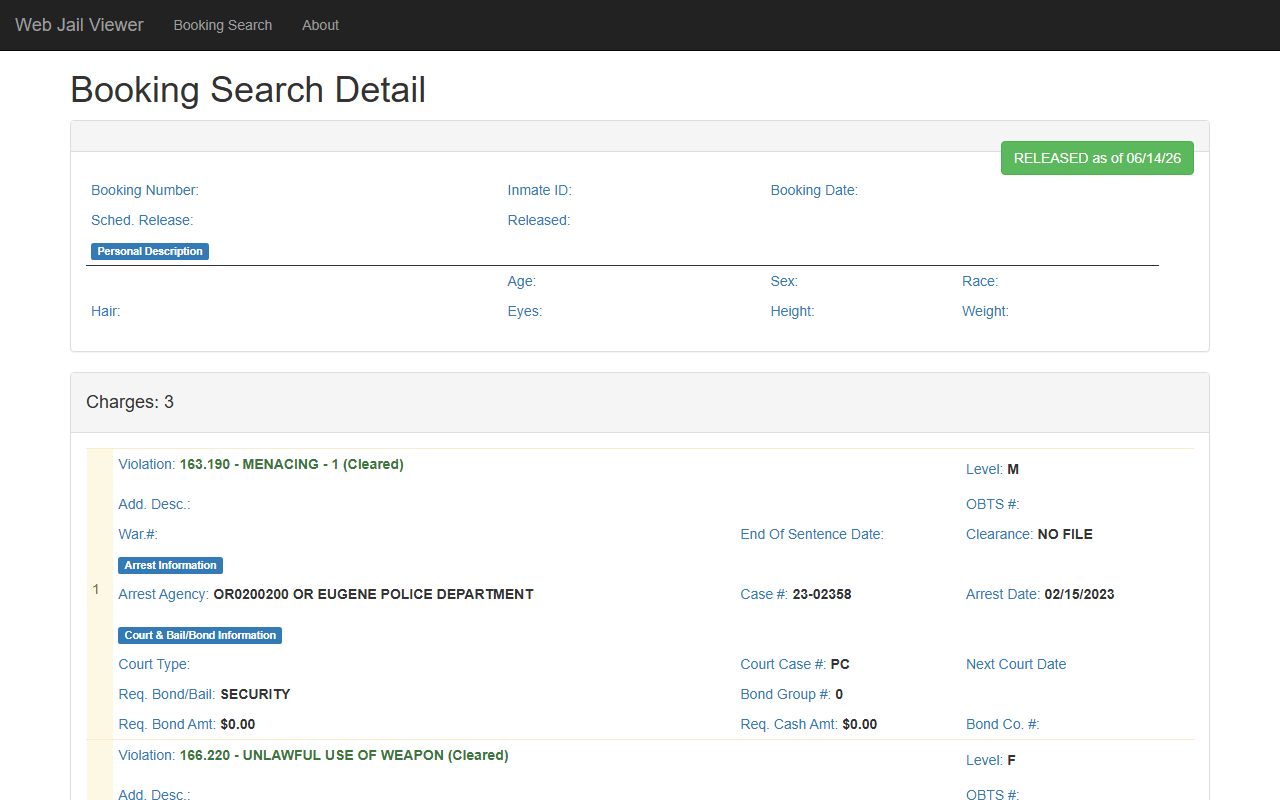
These fields help connect a booking to a court case, but each court status or warrant question still needs confirmation with the court or jail records.
District Attorney Role in Charge Records
The Lane County District Attorney's Office oversees the Criminal Division, Victim Services Division, Family Law Division for child support enforcement, Juvenile Prosecution Division, and Death Investigations. For many criminal cases, the DA's charging decision is the bridge between arrest records and the court charge record. The research identifies Christopher J. Parosa as the Lane County District Attorney appointed in 2024 after receiving nearly 67% of the May primary vote.
Official DA contact information from the research lists Lane County District Attorney's Office, 125 East 8th Avenue, Room 400, Eugene, Oregon 97401-2926; phone 541-682-4261; fax 541-682-3890. The DA does not operate the jail roster and is not the court clerk, but prosecutor filings shape the charges that appear in court.
State Custody and Charge Context
Oregon DOC Offender Search is separate from Lane County arrest records. It helps locate state prison or supervision records after a person has moved beyond local jail custody. It should not be used as a substitute for the Lane Web Jail Viewer, OJD court case search, or municipal court records. DOC also explains that official records requests use public-records channels rather than the public search page alone.
The Oregon DOC public offender search is one state-level custody search source.
Use DOC only when the question concerns state prison or supervision, not a fresh Lane County booking or filed charge.
The Oregon DOC offender-search explanation adds context for how DOC search and official record requests differ.
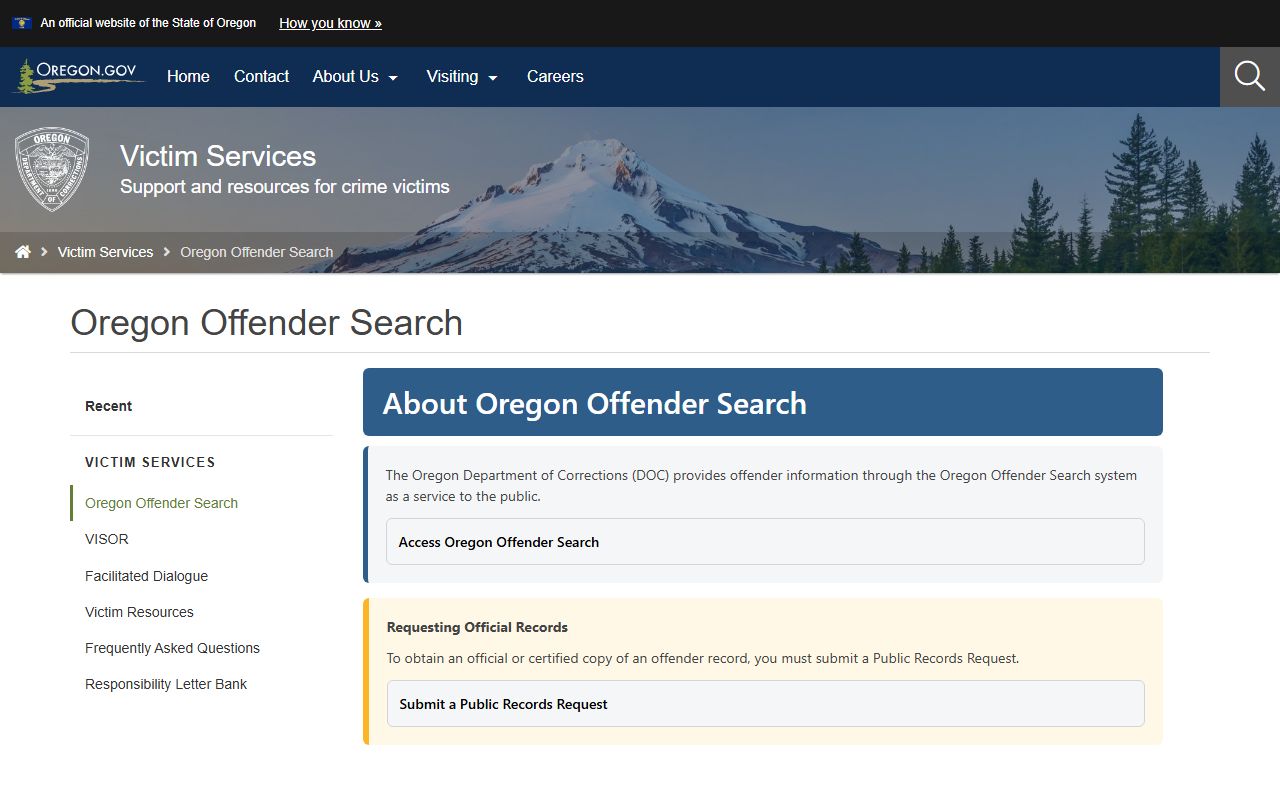
That distinction is important because a statewide offender result may reflect custody after conviction, while Lane County court charges may still need a separate court-record review.
Sealed vs. Set-Aside or Expunged Records
Oregon adult criminal relief is commonly described through the set-aside process under ORS 137.225 rather than casual deletion. Juvenile expunction is separate and governed by ORS 419A.260 and related sections. Once a court grants relief, public access changes according to the order and statute, but eligibility depends on offense type, waiting period, sentence status, later convictions, and statutory exclusions.
| Comparison Point | Sealed or Restricted | Set Aside / Expunged |
|---|---|---|
| Visibility | Hidden from ordinary public access by law, policy, or court order. | Adult set-aside or juvenile expunction changes access under a specific legal process. |
| Examples | Juvenile, adoption, mental health adjudication, VAWA-protected, and protected personal information. | Eligible adult arrests or convictions under ORS 137.225; juvenile expunction under ORS 419A. |
| How it happens | May be automatic by category or ordered by the court. | Usually requires a motion, petition, judgment, notice, or agency compliance process. |
| Practical caution | Absence from public search does not prove no record exists. | Not every charge, arrest, or conviction qualifies for relief. |
Background Check Considerations
Arrest records and court charges are often incomplete without disposition. A booking charge may never become a filed charge. A filed charge may be dismissed. A conviction may be set aside later. Anyone using public information for a regulated eligibility decision must use legally appropriate background-check procedures instead of casual web lookup.
Important: Public arrest and court-charge information is not an FCRA-compliant consumer report for employment, housing, credit, insurance, or similar decisions.
Restricted Charge Records in Lane County
OJD Online Records Search excludes juvenile matters, adoption records, mental health adjudications, and records or calendars protected by the Violence Against Women Act. Personal identifying information, including Social Security numbers and addresses, is not available through the public portal. Lane County NextRequest routes juvenile records through a release process and states only records permitted by Oregon law will be released.
For adult criminal matters, public search may show basic case information, parties, events, dispositions, hearings, and financial sections, but not documents. Court documents require courthouse terminals, OJCIN access for eligible users, or a records request. When a booking detail, OJD case entry, and agency record disagree, the safest approach is to treat them as different records from different stages and verify with the source agency or court.